Ferritin Quantitative Test

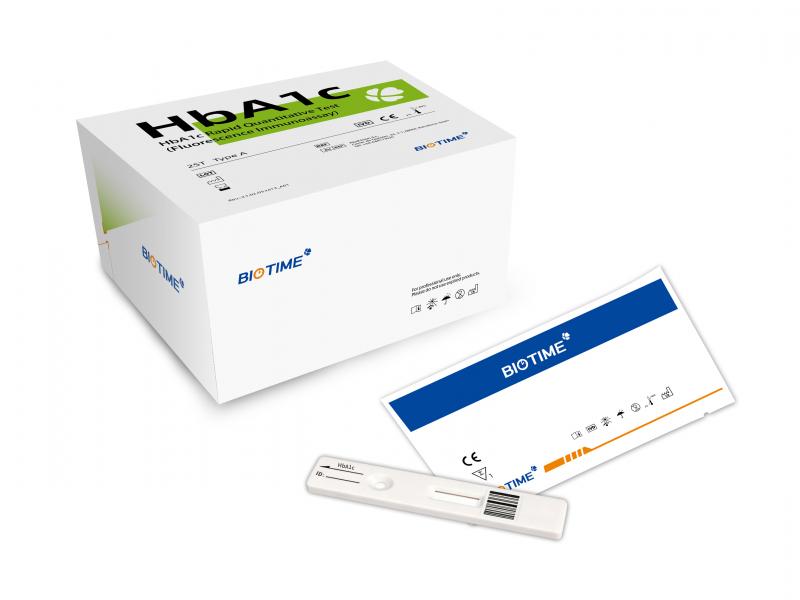
HbA1c Rapid Quantitative Test

HbA1c is the product of the hemoglobin combining with blood glucose in red blood cells, which can reflect the average blood glucose level over the amid 2-3 months.
Product Detail

Product Specification

Specimen Types
WB
Specimen Capacity
5μL
Reaction Time
5 min
Sample Capacity
80μL
Detection Range
4-15%


Clinical Significance

✔ The higher the level of glucose in the blood, the higher the level of hemoglobin A1c is detectable on red blood cells.

✔ Hemoglobin A1c levels correlate with average levels of glucose in the blood over an approximately three-month time.

✔ Normal ranges for hemoglobin A1c in people without diabetes is about 4% to 5.9%. People with diabetes with poor glucose control have hemoglobin A1c levels above 7%.

✔ Hemoglobin A1c levels are routinely used to determine blood sugar control over time in people with diabetes.

✔ Decreasing hemoglobin A1c levels by 1% may decrease the risk of microvascular complications (for example, diabetic eye, nerve, or kidney disease) by 10%.


Advantages

✔ Quick Reading time: 5 mins

✔ Shelf life: 24 months

✔ Sample type: Whole Blood

✔ Specialized capillary tube to collect samples directly

Leave A Message

Please provide us with the information below, and we'll contact you as soon as possible.
Related Products
biotime MAU Rapid Quantitative Test
MAU Rapid Quantitative Test
MAU(Microalbumin) occurs when the kidney leaks small amounts of albumin into the urine, which is an early marker of kidney damage.
Cys C Rapid Quantitative Test
Cys-C Rapid Quantitative Test
Serum Cystatin C(Cys-C) has been proposed as a marker of glomerular filtration rate(GFR). Serum creatinine (creatinine) is widely used to estimate the glomerular filtration rate, but its tubular secretion, dependence on muscle mass, alteration in some inflammatory diseases, and analytical interferences can limit its utility. Thus, Cys-C has been proposed as a novel biomarker of kidney function.
biotime AFP Rapid Quantitative Test
AFP Rapid Quantitative Test
Alpha-fetoprotein (AFP) is a protein produced primarily by the liver in a developing baby (fetus) and the portion of a developing embryo that is similar to the yolk cavity in bird eggs (yolk sac tissues). AFP levels are typically elevated when a baby is born and then decline rapidly.
hs-cTnT Rapid Quantitative Test (Chemiluminescence Immunoassay)
hs-cTnT Rapid Quantitative Test (Chemiluminescence Immunoassay) is used for in vitro quantitative detection of the high sensitivity cardiac isoform of TnT (hs-cTnT) concentration in human serum, plasma that contains heparin /EDTA and other anticoagulants and venous whole blood samples, mainly used for auxiliary diagnosis of cardiac diseases.
biotime PGI PGII Rapid Quantitative Test
PGI/PGII Rapid Quantitative Test
Human pepsinogens I (PGI) and II (PGII) are proenzymes of pepsin—an endoproteinase of gastric juice. PGI is secreted mainly by chief cells in the fundic mucosa, whereas PGII is also secreted by the pyloric glands and the proximal duodenal mucosa. Serum PGI and PGII concentrations and the ratio between PGI and PGII may be related to the histologic and functional status of the gastric mucosa.
Biotime 25(OH)D Rapid Quantitative Test
25(OH)-D Rapid Quantitative Test
25(OH)-D is a prehormone that is produced in the liver by hydroxylation of vitamin D3 (cholecalciferol) by the enzyme cholecalciferol 25-hydroxylase. Physicians worldwide measure this metabolite to determine a patient's vitamin D status.
Biotime cTnI rapid quantitative test
cTnI Rapid Quantitative Test
cTnI is a myocardial marker with high specificity and good sensitivity. The Biotime cTnI test kit has a wide detection range and high accuracy.
TT3 Rapid Quantitative Test (Chemiluminescence Immunoassay)
TT3 Rapid Quantitative Test (Chemiluminescence Immunoassay) is used for in vitro quantitative detection of the Total Triiodothyronine (TT3) concentration in human serum, plasma that contains heparin /EDTA and other anticoagulants and venous whole blood samples, mainly used for auxiliary diagnosis of thyroid diseases.
Leave A Message

Leave A Message

    Please provide us with the information below, and we'll contact you as soon as possible.
Home

products

about

contact