Ferritin Quantitative Test

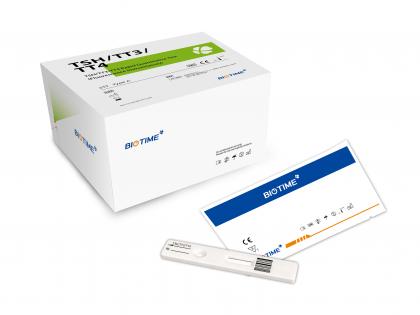
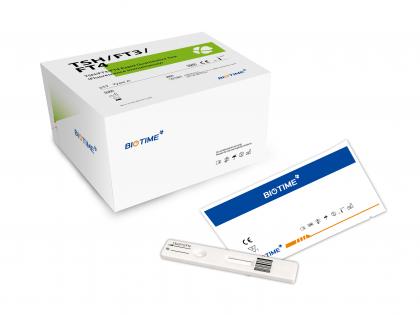
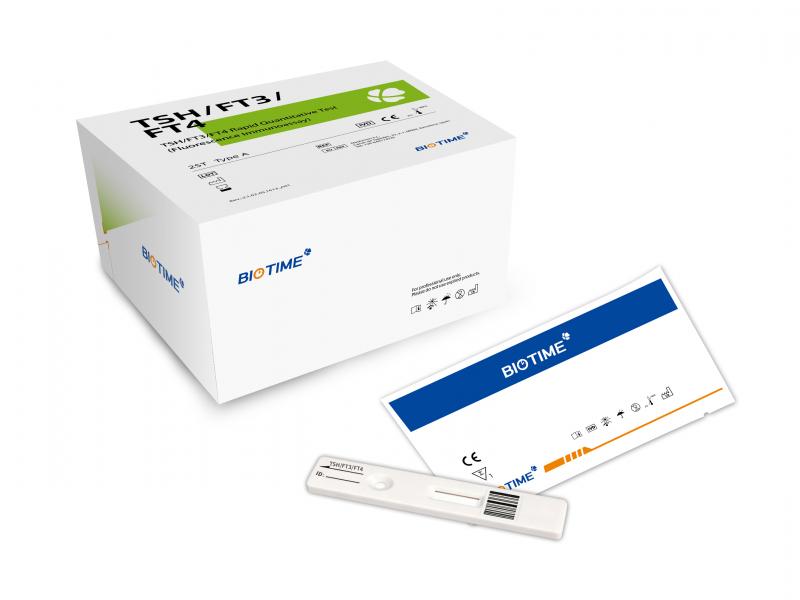
TSH/FT3/FT4 Rapid Quantitative Test (Fluorescence Immunoassay)

The BiotimeTSH/FT3/FT4Rapid Quantitative Test is intended to quantitatively detect the concentration of thyroid-stimulating hormone (TSH), free triiodothyronine (FT3), and free thyroxine (FT4) in human serum and plasma samples on the Biotime FIA Analyzer by fluorescent immunoassay. The test is used as an adjunctive diagnosis of thyroid function.

For in vitro diagnostic use only. For professional use only.

Product Detail

Specimen Types

Serum/Plasma

Sample

Serum/Plasma:50μL

Reaction Time

15 min

Reference Interval  

TSH: 0.29-4.16mIU/L

FT3: 3.12-6.76 pmol/L

FT4: 11.80-22.47pmol/L


Clinical Significance:


1. TSH - A Sensitive Indicator of Thyroid Function

TSH is secreted by the pituitary and regulated by negative feedback from FT3 and FT4.

Changes in TSH occur more rapidly and significantly than changes in FT3/FT4, making it a highly sensitive marker for assessing the hypothalamicpituitarythyroid axis.

Particularly valuable for diagnosing subclinical hyperthyroidism and subclinical hypothyroidism, where FT3/FT4 may still be within normal ranges.


2. Clinical Utility in Disease Differentiation

Increased TSH is seen in: primary hypothyroidism, thyroid hormone resistance syndrome, ectopic TSH syndrome, TSHsecreting tumors, and certain drug effects (dopamine antagonists, iodinecontaining drugs).

Decreased TSH is seen in: hyperthyroidism, subclinical hyperthyroidism, prolactinoma, hypercortisolism, acromegaly, and excessive use of glucocorticoids or antithyroid drugs.

Measuring TSH helps distinguish primary hypothyroidism (high TSH) from secondary/tertiary hypothyroidism (low or inappropriately normal TSH), which is often difficult based on clinical presentation alone.


3. FT3 and FT4-Direct Markers of Thyroid Function

FT3 and FT4 are the free, physiologically active forms of thyroid hormones, unaffected by changes in thyroid hormonebinding proteins.

They directly reflect functional thyroid status and offer higher sensitivity and specificity than total T3/T4 (TT3/TT4).

Combined with TSH, they provide the most intuitive assessment of thyroid function.


4. Synergistic Clinical Application

The threemarker panel (TSH, FT3, FT4) is the standard for evaluating thyroid disorders, including:

Diagnosis and monitoring of hyperthyroidism and hypothyroidism

Detection of subclinical thyroid dysfunction

Differentiation between primary and central (pituitary/hypothalamic) causes of thyroid disease

Monitoring response to antithyroid or thyroid hormone replacement therapyh test).

Leave A Message

Please provide us with the information below, and we'll contact you as soon as possible.
Related Products
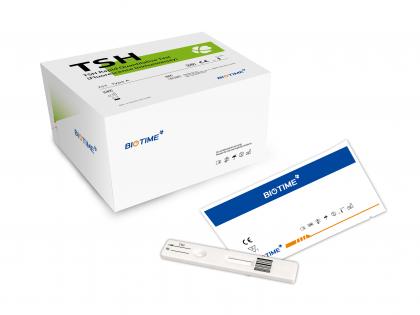
biotime TSH Rapid Quantitative Test
TSH Rapid Quantitative Test
Thyroid stimulating hormone(TSH) is a hormone secreted by adenohypophysis to promote the growth and function of the thyroid gland. The changes of TSH is noted prior to the T4 and T3 for months or years, as is of great value for the diagnosis of thyroid dysfunction and lesions.
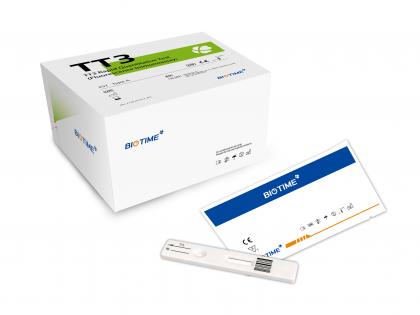
 TT3 Rapid Quantitative Test
TT3 Rapid Quantitative Test
TT3 is the main hormone that thyroid hormone does to various target organs. The serum TT3 concentration reflects the thyroid gland’s ability to function better than the thyroid gland. TT3 is an important indicator of early hyperthyroidism and the monitoring of recurrent hyperthyroidism and pseudo thyrotoxicosis.
bioitime TT4 Rapid Quantitative Test
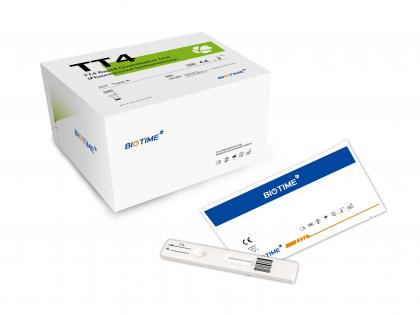
TT4 Rapid Quantitative Test
TT4 is the main product of thyroid secretion and is an essential ingredient in the integrity of the hypothalamic-pituitary gland. The TT4 measures can be used for the diagnosis of hyperthyroidism, primary and secondary, and TT4 inhibition of treatment.
Biotime fT3 Rapid Quantitative Test
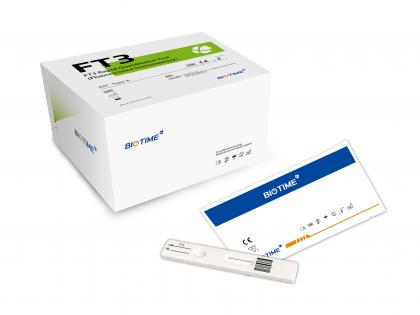
FT3 Rapid Quantitative Test (Fluorescence Immunoassay)
The Biotime FT3 Rapid Quantitative Test is intended to quantify the concentration of FT3 in human serum on the Biotime FIA Analyzer (Semi-automatic / Automatic) by fluorescent immunoassay. The test is used as an aid in the detection of hyperthyroidism. -Fluorescence immunoassay -hyperthyroidism For in vitro diagnostic use only. For professional use only.
Biotime fT4 Rapid Quantitative Test
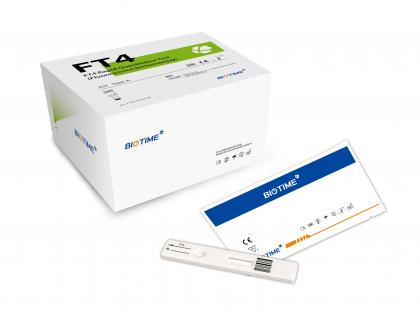
FT4 Rapid Quantitative Test (Fluorescence Immunoassay)
The Biotime FT4Rapid Quantitative Test is intended to quantify the concentration of FT4 in human serum on the Biotime FIA Analyzer (Semi-automatic / Automatic) by fluorescent immunoassay. The test is used as an aid in the detection of hyperthyroidism. -Fluorescence immunoassay -hyperthyroidism For in vitro diagnostic use only. For professional use only.
TSH/TT3/TT4 Rapid Quantitative Test (Fluorescence Immunoassay)
The Biotime TSH/TT3/TT4Rapid Quantitative Testis intended to quantitatively detect theconcentration of thyroid stimulating hormone (TSH),total triiodothyronine (TT3) and total thyroxine (TT4) in human serum and plasma samples on Biotime FIA Analyzer byfluorescent immunoassay. The test is used as an aiddiagnosis of thyroiddisease. For in vitro diagnostic use only. For professional use only.
biotime PGI PGII Rapid Quantitative Test
PGI/PGII Rapid Quantitative Test
Human pepsinogens I (PGI) and II (PGII) are proenzymes of pepsin—an endoproteinase of gastric juice. PGI is secreted mainly by chief cells in the fundic mucosa, whereas PGII is also secreted by the pyloric glands and the proximal duodenal mucosa. Serum PGI and PGII concentrations and the ratio between PGI and PGII may be related to the histologic and functional status of the gastric mucosa.
biotime CEA Rapid Quantitative Test
CEA Rapid Quantitative Test
Carcinoembryonic antigen (CEA) is a protein normally found in very low levels in the blood of adults. The CEA blood level may be increased in certain types of cancer and non-cancerous (benign) conditions. A CEA test is most commonly used for colorectal cancer.
Leave A Message

Leave A Message

    Please provide us with the information below, and we'll contact you as soon as possible.
Home

products

about

contact