Ferritin Quantitative Test

FT4 Rapid Quantitative Test (Fluorescence Immunoassay)

The Biotime FT4Rapid Quantitative Test is intended to quantify the concentration of FT4 in human serum on the Biotime FIA Analyzer (Semi-automatic / Automatic) by fluorescent immunoassay. The test is used as an aid in the detection of hyperthyroidism.

-Fluorescence immunoassay

-hyperthyroidism

For in vitro diagnostic use only. For professional use only.

Product Detail
Introduction
Thyroxine (T4) is the main thyroid hormone secreted into the bloodstream by the thyroid gland. Together with triiodothyronine (T3) it plays a vital role in regulating the body's metabolic rate, influences the cardiovascular system, growth and bone metabolism, and is important for normal development of gonadal functions and nervous system[1]. T4 circulates in the bloodstream as an equilibrium mixture of free and serum bound hormone. Free T4 (fT4) is the unbound and biologically active form, which represents only 0.03% of the total T4. The remaining T4 is inactive and bound to serum proteins such as thyroxine binding globulin (TBG) (75%), pre-albumin (15%), and albumin (10%)[2-5]. The determination of free T4 has the advantage of being independent of changes in the concentrations and binding properties of these binding proteins; additional determination of a binding parameter (T - uptake, TBG) is therefore unnecessary. Thus free T4 is a useful tool in clinical routine diagnostics for the assessment of the thyroid status.

Product Specification

Specimen Types
Serum
Specimen Capacity
40μL
Reaction Time
15 min
Sample Capacity
80μL
Detection Range
0.3~100pmol/L

Advantages
Independent packaging to solve the problem of validity after opening
Simple operation and fast response

Clinical significance
✔ to help evaluate thyroid gland function
✔ to help diagnose thyroid disease
✔ to monitor effectiveness of thyroid treatment
✔ sometimes a free T4 is used to help diagnose congenital hypothyroidism in newborns

Intent use

Outpatient department, emergency department, endocrinology department, obstetrics and gynecology department, physical examination center


Reference

1. Kronenberg HM, Melmed S, Polonsky KS, et al. Williams Textbook of Endocrinology. Saunders Elsevier, Philadelphia, 12th edition, 2011, chapter 10, p. 301-311.
2. Robbins J, Rall JE. The interaction of thyroid hormones and protein in biological fluids. Recent Prog Horm Res 1957;13:161-208.
3. Oppenheimer JH. Role of plasma proteins in the binding, distribution and metabolism of the thyroid hormones. N Engl J Med 1968;278(21):1153-1162.
4. DeGroot LJ, Larsen PR, Hennemann G. Transport of thyroid hormone and cell uptake. The thyroid and its diseases. Wiley and Sons, New York, 1984:62-65.
Ekins RP. Measurement of free hormones in blood. Endocr Rev 1990;11(1):5-46.

Leave A Message

Please provide us with the information below, and we'll contact you as soon as possible.
Related Products
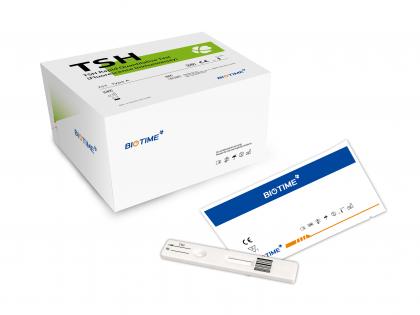
biotime TSH Rapid Quantitative Test
TSH Rapid Quantitative Test
Thyroid stimulating hormone(TSH) is a hormone secreted by adenohypophysis to promote the growth and function of the thyroid gland. The changes of TSH is noted prior to the T4 and T3 for months or years, as is of great value for the diagnosis of thyroid dysfunction and lesions.
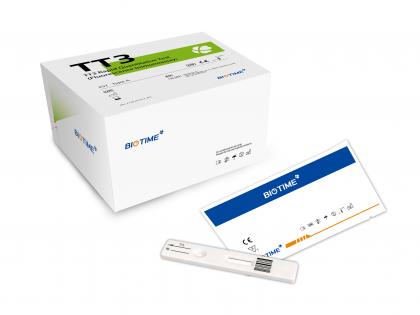
 TT3 Rapid Quantitative Test
TT3 Rapid Quantitative Test
TT3 is the main hormone that thyroid hormone does to various target organs. The serum TT3 concentration reflects the thyroid gland’s ability to function better than the thyroid gland. TT3 is an important indicator of early hyperthyroidism and the monitoring of recurrent hyperthyroidism and pseudo thyrotoxicosis.
bioitime TT4 Rapid Quantitative Test
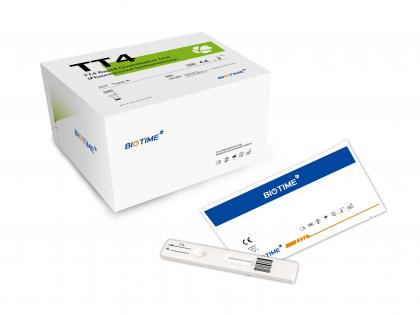
TT4 Rapid Quantitative Test
TT4 is the main product of thyroid secretion and is an essential ingredient in the integrity of the hypothalamic-pituitary gland. The TT4 measures can be used for the diagnosis of hyperthyroidism, primary and secondary, and TT4 inhibition of treatment.
Biotime fT3 Rapid Quantitative Test
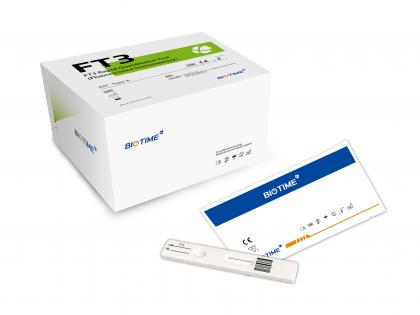
FT3 Rapid Quantitative Test (Fluorescence Immunoassay)
The Biotime FT3 Rapid Quantitative Test is intended to quantify the concentration of FT3 in human serum on the Biotime FIA Analyzer (Semi-automatic / Automatic) by fluorescent immunoassay. The test is used as an aid in the detection of hyperthyroidism. -Fluorescence immunoassay -hyperthyroidism For in vitro diagnostic use only. For professional use only.
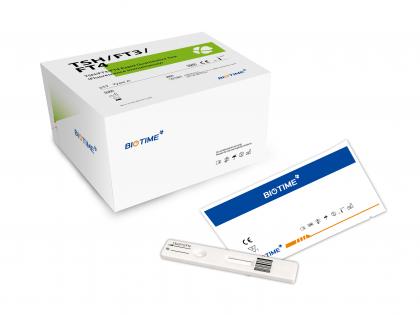
TSH/FT3/FT4 Rapid Quantitative Test (Fluorescence Immunoassay)
The BiotimeTSH/FT3/FT4Rapid Quantitative Test is intended to quantitatively detect the concentration of thyroid-stimulating hormone (TSH), free triiodothyronine (FT3), and free thyroxine (FT4) in human serum and plasma samples on the Biotime FIA Analyzer by fluorescent immunoassay. The test is used as an adjunctive diagnosis of thyroid function. For in vitro diagnostic use only. For professional use only.
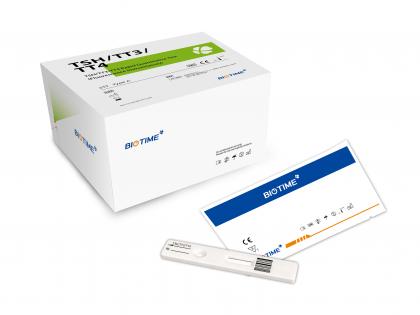
TSH/TT3/TT4 Rapid Quantitative Test (Fluorescence Immunoassay)
The Biotime TSH/TT3/TT4Rapid Quantitative Testis intended to quantitatively detect theconcentration of thyroid stimulating hormone (TSH),total triiodothyronine (TT3) and total thyroxine (TT4) in human serum and plasma samples on Biotime FIA Analyzer byfluorescent immunoassay. The test is used as an aiddiagnosis of thyroiddisease. For in vitro diagnostic use only. For professional use only.
Biotime Ferritin Rapid Quantitative Test
Ferritin Rapid Quantitative Test
Ferr is a universal intracellular protein that stores iron and releases it in a controlled fashion. The protein is produced by almost all living organisms, including algae, bacteria, higher plants, and animals. In humans, it acts as a buffer against iron deficiency and iron overload. Ferritin is found in most tissues as a cytosolic protein, but small amounts are secreted into the serum functioning as an iron carrier. Plasma ferritin is also an indirect marker of the total amount of iron stored in the body. Hence serum ferritin is used as a diagnostic test for iron-deficiency anemia.
biotime fPSA Rapid Quantitative Test
fPSA Rapid Quantitative Test
PSA, a protein produced by prostate gland cells, circulates through the body in two ways: either bound to other proteins or on its own. PSA traveling alone is called free PSA. The free-PSA test measures the percentage of unbound PSA.
Leave A Message

Leave A Message

    Please provide us with the information below, and we'll contact you as soon as possible.
Home

products

about

contact