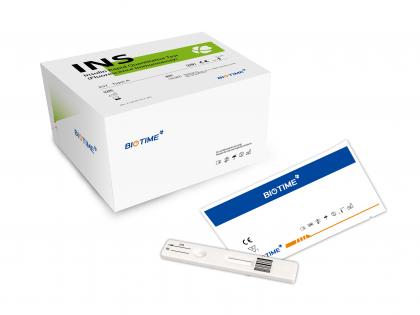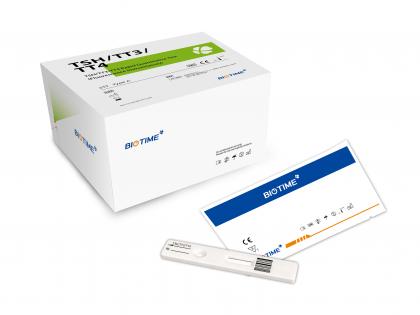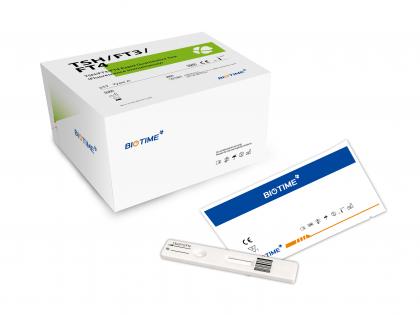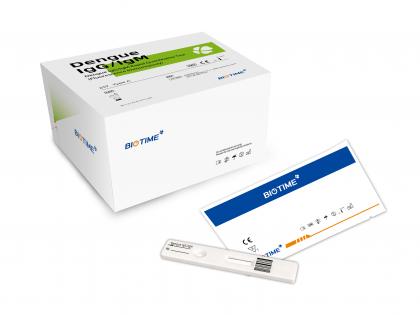
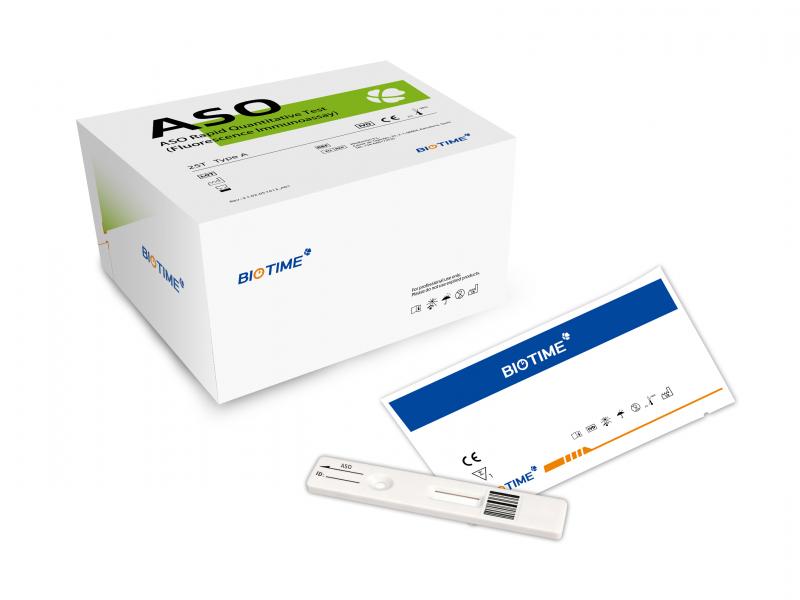
The Biotime ASO Rapid Quantitative Test is intended to quantify the concentration of ASO in human serum, plasma and whole blood onBiotime FIA Analyzer by fluorescent immunoassay. The test is used as an aid detection of auxiliary diagnosis of acute rheumatic fever.
-Fluorescence immunoassay
-Auxiliary diagnosis of acute rheumatic fever
For in vitro diagnostic use only. For professional use only.
The Biotime ASO Rapid Quantitative Test is intended to quantify the concentration of ASO in human serum, plasma and whole blood onBiotime FIA Analyzer by fluorescent immunoassay. The test is used as an aid detection of auxiliary diagnosis of acute rheumatic fever.
-Fluorescence immunoassay
-Auxiliary diagnosis of acute rheumatic fever
For in vitro diagnostic use only. For professional use only.
Specification
|
Specimen Types |
WB/S/P |
|
Sample |
Whole Blood: 15μL; Serum/Plasma: 10μL |
|
Reaction Time |
15 min |
|
Assay Range |
20.0~2000.0IU/mL |
Clinical Significance:
Confirms recent Group A Streptococcus (GAS) infection
Aids diagnosis of post-streptococcal complications:
Acute Rheumatic Fever (ARF)
Post-streptococcal glomerulonephritis
Pediatric Autoimmune Neuropsychiatric Disorders Associated with Streptococcal Infections (PANDAS)
Key Points:
Antibodies rise 1–3 weeks post-infection, peak at 3–5 weeks, and decline over 6–12 months
Positive in only 80–85% of GAS infections → negative result does not rule out infection
Serial rising titers (paired samples 10–28 days apart) provide stronger evidence than a single measurement
Upper limit of normal varies by age, region, and population (e.g., children: up to 515 IU/mL in some studies)
Combined with anti-DNase B increases sensitivity to ~95% for detecting prior GAS infection
Please provide us with the information below, and we'll contact you as soon as possible.




Copyright © 2013-2026 Xiamen Biotime Biotechnology Co., Ltd.. All Rights Reserved.
 IPv6 network supported